- Points of View
- Resources
- Reference Materials
Navigating the AI Vendor Map: A Guide for RIAs
By Mike Shannon
About the author: Mike Shannon serves as CEO of Impruve, the pioneering AI Steward for Wealth Management and co-commissioner (with Future Proof Research) of the “State of AI in Wealth Management” research. Relevant to this piece regarding software vendors, Mike has personally managed over 50 VC-backed board meetings throughout the process of founding & exiting a previous SaaS company that was fully acquired by a private equity firm in 2024.
“It feels like every other week I’m being pitched a shiny new AI tool. How do I navigate it all? …We really don’t want to mess this up.”
Thoughtful RIA leaders ask us some variant of this question every single week. These are exciting yet confusing times, especially in the heavily regulated wealth management industry. This write-up is intended to provide a pragmatic framework around the challenge of “navigating the vendor map” while architecting the AI-native future of your firm.
First, I should state that at Impruve, we hold a fundamental and potentially unpopular view regarding the current state of software. I’d first heard it expressed in these terms by a mentor of mine, Rick Desai, who teaches new ventures at Northwestern Kellogg, then again by a prominent software venture capitalist friend of ours, Guy Turner, and I’ve observed it take form firsthand within RIAs. The view is this:
“Much of the value in software will ultimately accrue to the frontier LLMs” (Claude, OpenAI, etc.)
That doesn’t mean that all software gets wiped away as was dramatically depicted in Citrini Research’s THE 2028 GLOBAL INTELLIGENCE CRISIS, but it does likely mean that the value provided by any given vendor software solution is a much thinner layer around the LLM than in the previous world of SaaS.
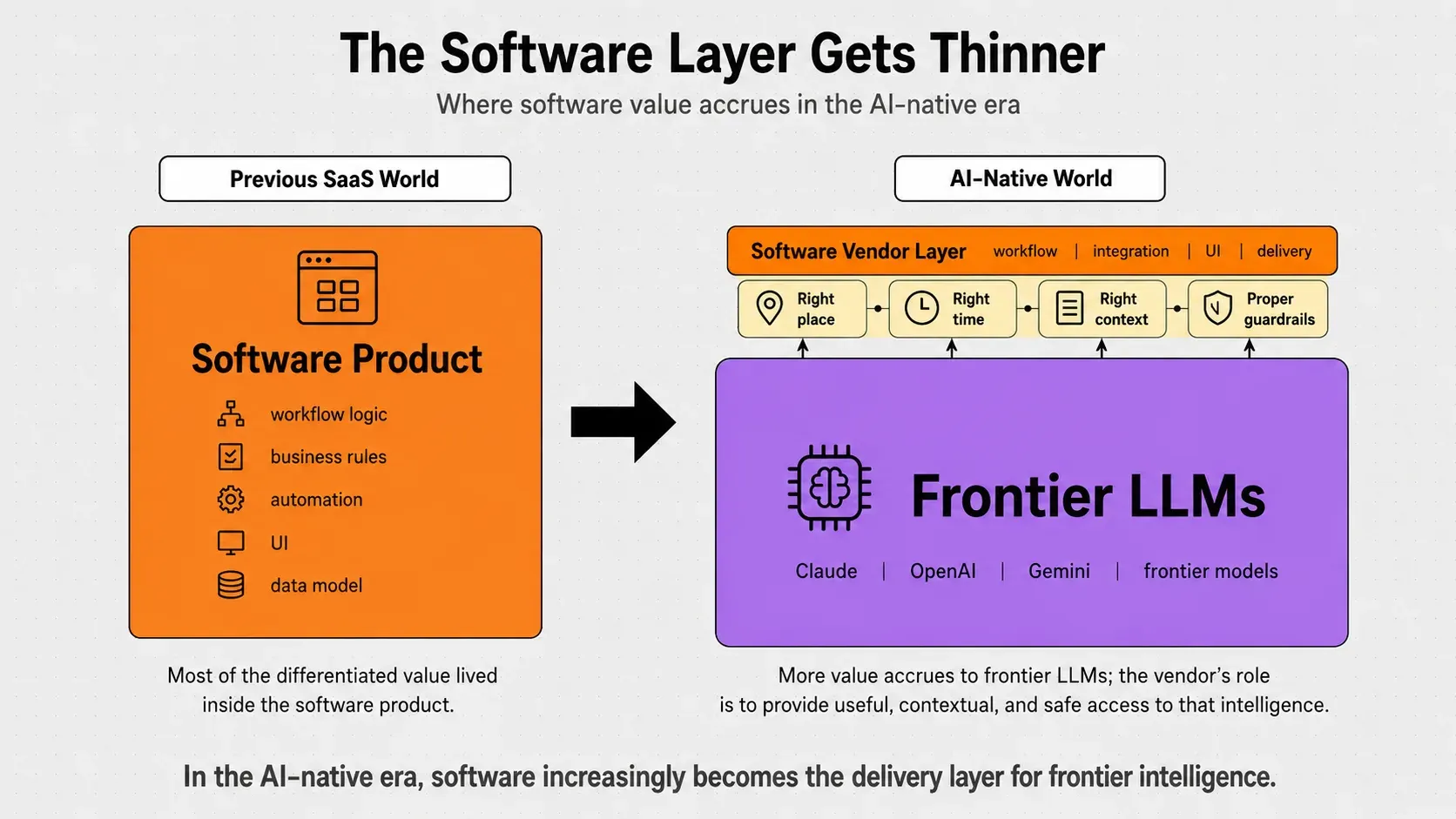
In this new reality, the remaining promise of nearly any effective software vendor is to provide access to the underlying LLM (Claude, OpenAI, etc.) at the:
- Right place
- Right time
- Right context
- Proper guardrails
In other words, when buying a software tool, what you’re really buying is a specialized manner of leveraging the intelligence of an underlying LLM (or set of orchestrated LLMs).
That’s an important dynamic to understand, because it impacts the fundamental tension that I believe exists right now between RIAs and the Tech Vendor Map. It’s a “Tale of Two Board Rooms”, as such:
The software company’s board is asking…
“In this crowded AI landscape, how do we establish & secure our moat?”
The RIA’s executive team is asking…
“In this evolving AI landscape, how do we future-proof our optionality?”
Moat vs. Optionality.
Lock-in vs. Autonomy.
My intention is not to knock the SaaS vendors. For the most part, I deeply respect each of these entrepreneurs & executives. If, in the pre-LLM days, software entrepreneurship was a difficult chess game, it is now a 3D chess game.
As Michael Kitces put it during his last Future Proof keynote:
“…Because in the old days of like 2 years ago, if you were starting a company, you raised a little bit of money to get enough engineers to spend 6, 12, 18 months building something and then you would put it out to the world, find out if anybody cared. …But now that companies can build prototypes and tools so much more rapidly, the game starts to shift. Now, it’s not a question of can you build the software. It’s if you build the software, can you get it into the hands of advisers or whoever your audience is. And that’s not actually an engineering software building game. That’s a marketing game. And if you want to spend money on marketing, there’s kind of like an unlimited amount of pool that you could just pour that into, right? More events, more sponsorships, more ads, more stuff. And so what that means is companies now are raising much larger dollar amounts much earlier in the process than what typically happened with raising capital in the past because they, say, build a fast prototype, seems cool, people are interested, ‘let’s go raise like $15 million and sponsor every single conference in existence and see how many people will buy it.’ And you’re going to see more of that in the future.”
— Michael Kitces
That renders a lot of noisy buzz for an RIA’s executive team to sift through. So, what do you do?
Waiting on the AI-sidelines isn’t the answer, as it entails the opportunity cost of under-developing your organization’s “AI muscles” and falling behind on the change management aspect inherent to any firm’s AI-native evolution. As Anthropic’s CEO Dario Amodei puts it, leveraging AI is an “empirical science”, in that you learn best by doing.
Moving forward is imperative. However, you can do so in a shrewd manner. Here’s a simple threefold guide:
- Map your Jobs to be Done (JTBD)
- Assess your evolving “task delegation”
- Whenever buying a tool, ensure you have optionality to change your mind later on (and assurance of the actual migration path if so).
1 & 2. Mapping your Jobs to be Done (JTBD) + assessing your evolving “task delegation”
Whether achieved by a human staff, vendor, or LLM, a pragmatic mindset still revolves around a finite set of “Jobs to Be Done” (JTBD). Map these out, then delegate accordingly. Even when the conversation is around AI, I still find it helpful to start with a human-oriented approach first:
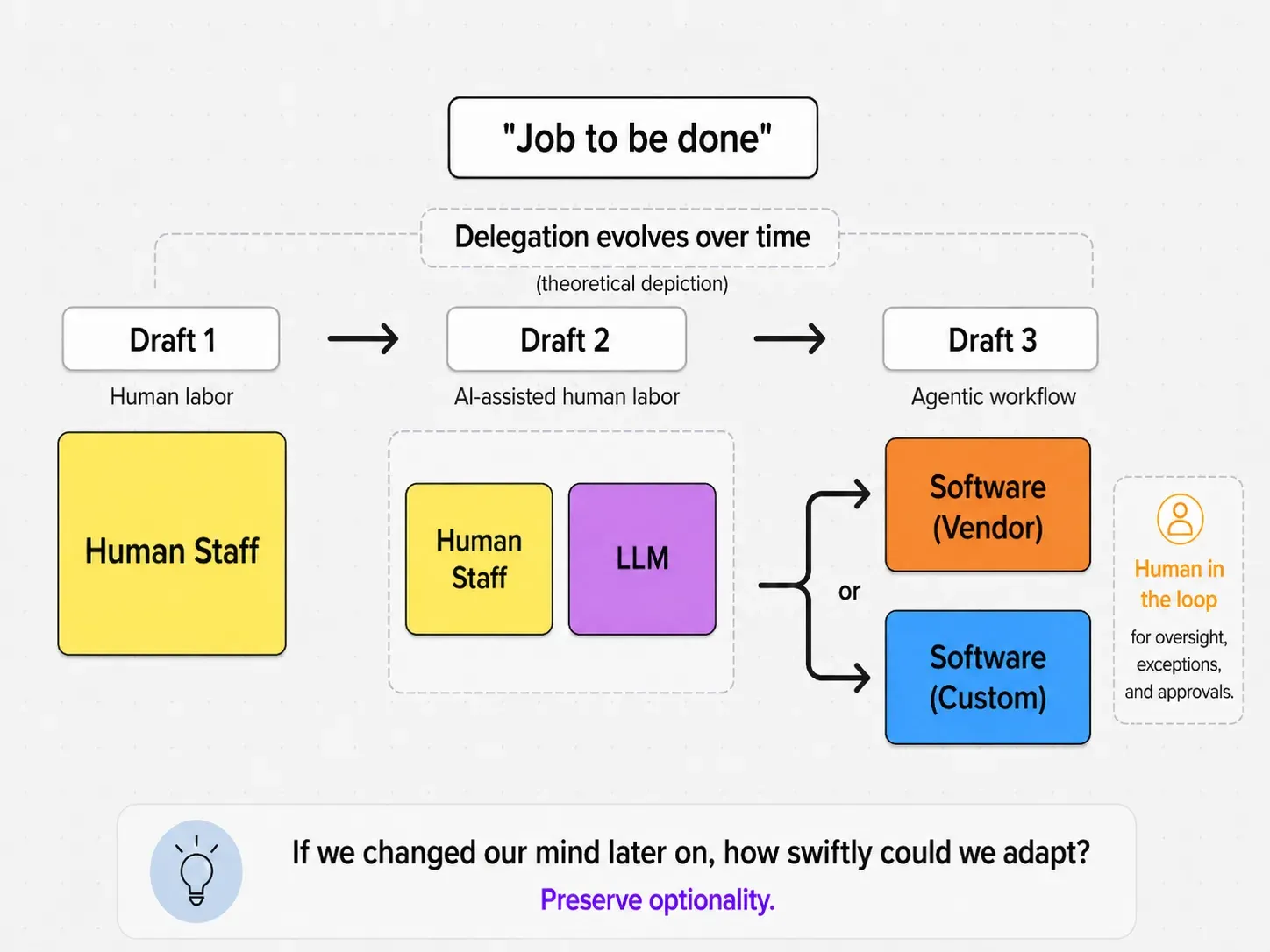
→ “If a human were doing this, what steps would they take?” →→ “If a human-in-the-loop LLM workflow did this, what would it look like?” →→→ “How much tighter could this workflow be with a vendor or custom software?” →→→→ “If we changed our mind later on, how swiftly could we adapt?”
In my own organizations, I like to consider the parable of the Ship of Theseus, the ancient metaphor of a vessel that remains in motion while each plank is eventually replaced by a stronger one over time.
Applying that metaphor to an RIA: just as a scaling advisor has always delegated sets of tasks to a human staffer, that staffer now delegates tasks to their initial AI tooling. Importantly, as the LLMs & vendor map evolve, you may decide to delegate that task to a different tool later on.
For example, an innovative AI Champion within an RIA may spin up custom Claude Skills for their own utility. That may be a starting point that is later “delegated” to a specialized software vendor, or kept in house yet upgraded to “enterprise grade” with a custom software build out.
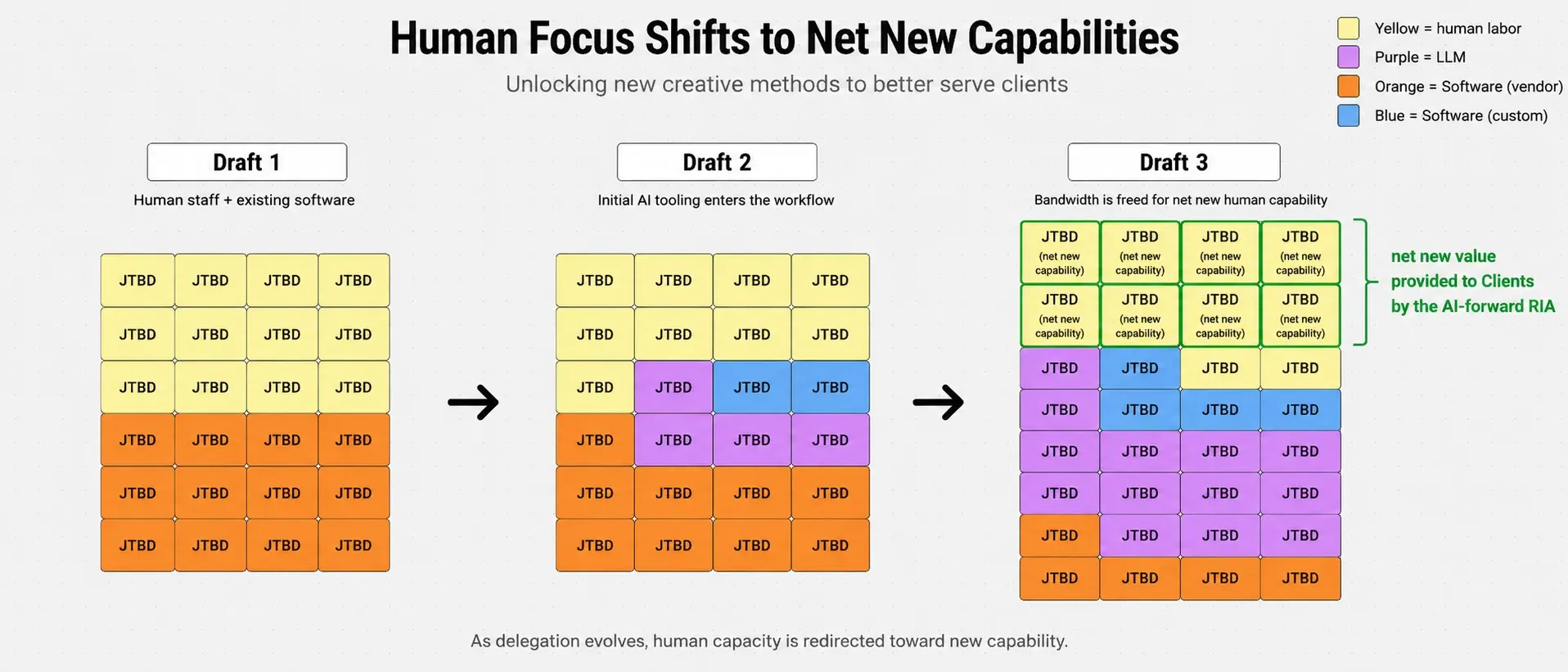
Each time those “next draft” iterations take form, bandwidth is freed up by the human staff. While the accompanying “fear” narrative tends to revolve around human-replacement, the “abundance” perspective revolves around unlocking net new capabilities with which to creatively serve clients.
In that mentality, perhaps the shifting “jobs to be done” delegation evolves in a trajectory along these lines:
Ok, so back to navigating the vendor map. How does an RIA gain peace-of-mind that they’ve future-proofed their optionality?
3. Securing your optionality when buying a tool
1. Ensure data portability
This is non-negotiable, and shouldn’t be left to “we’ll square it up later.” Get it in writing, and ask for a sample data file that your data ops lead can assess and approve. Not all data exports are created equal, and although the vendor may technically be offering you “data portability”, whether it’s made easy or difficult in that potential moment of “breaking up with the vendor”, should be clarified upfront.
2. Assess the vendor’s “open garden” vs. “closed garden” posture
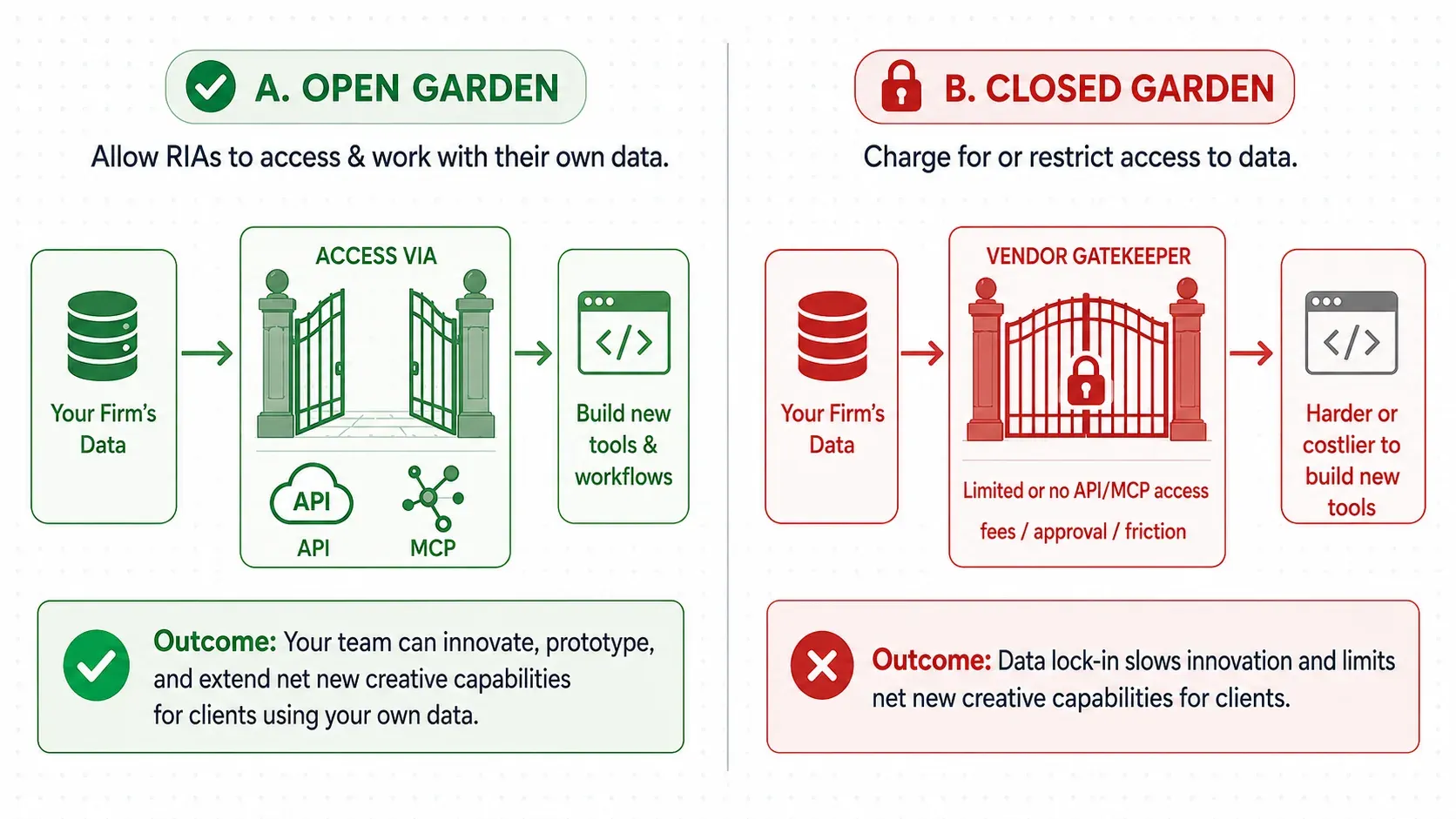
If the given platform is a source of data, that company is currently facing a fundamental posture question. They either:
A.) lean into the “open garden” posture of allowing RIAs to access & work with their own data, or
B.) attempt to extend the “closed garden” nature of limiting access to that data.
Theoretically, six months down the road, if the vibe-coding AI Champion on your ops team wanted to use your firm’s data stored in the vendor’s platform to build a prototype for a new homegrown tool/workflow, would they be able to access it via API or MCP? Is the cost to doing so reasonable? If not, that’s indicative of a “closed garden” posture, which is at least worth being aware of in your vendor selection process.
3. Clarify your service level
Remember, there’s a reason why Anthropic teamed up with Blackstone, Hellman & Friedman, and Goldman Sachs to launch their dedicated AI services firm:
“Claude’s capabilities change on a monthly or even weekly basis, which creates a different kind of engineering challenge than traditional software deployment. The systems that companies build with AI need to evolve as the models underneath them improve.”
With the ground shifting beneath all of us, you should expect to need to roll up your sleeves throughout time when wrangling AI to do effective work for you and your team. So when you evaluate a vendor, look deeper than the marketing headlines. Back to Michael Kitces’ point about the vanity metric of “capital raised”: a war chest tells you how aggressively a vendor can market, not necessarily how well they’ll serve you. Ask:
- What do their growth goalposts incentivize them to prioritize?
- Do those priorities align with yours?
- And when your implementation of the tool encounters a rough patch six months in, who picks up the phone, how fast, and at what cost?
We’re in the early innings of this exhilarating AI-powered future. You’re probably in better shape than you think, so long as your RIA develops the organizational muscles and AI architecture to keep iterating as our shared ecosystem evolves.
Remember, your job is not to perfectly predict every winning vendor, but to build an organization capable of changing its mind.